Showing posts with label ELP. Show all posts

Tuesday, 21 March 2017

Take A Pebble (Emerson, Lake & Palmer, 1970)

I don't need to introduce such a masterpiece to my readers. I just like to remember how important "Take A Pebble" was in the powerful trio history. Not only this track is one of their early achievements, but it also features all the highlights they'd be famous for. A gentle ballad, an awesome piano, a diversified and unpredictable structure and, of course, a mix of different genres, from folk to jazz and from the symphonic rock arrangement to the improvisation-like section.

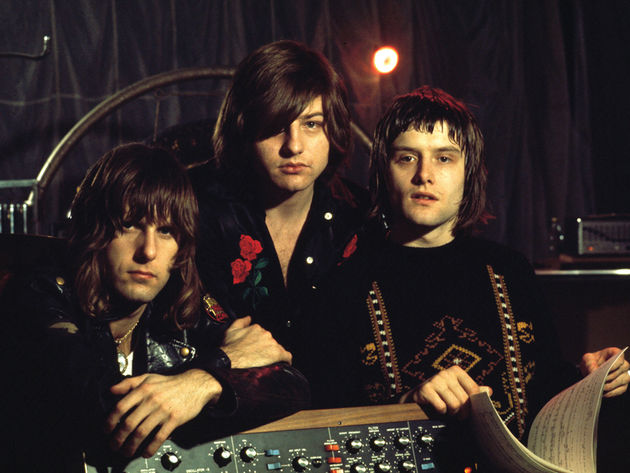
Young and prog... ladies and gentlemen, ELP.

The rythmic pattern is a very original one, including soft percussions and hand clapping, while Greg Lake's beautiful voice tops the cake. This is how prog rock should sound like: gentle and sparkling, flowing and - most of all - open minded. About the lyrics, the metaphor sea = life can be a largely exploited one, but is beautifully written and matches the music perfectly. What else? Just listen to this once more...

Thursday, 10 September 2015

Abaddon's Bolero (Emerson, Lake & Palmer, 1972)

"Abaddon's Bolero" is one of the tracks gracing ELP's "Trilogy" album and probably one of Emerson's best tracks. The structure and the title of this track have a patent reference to Ravel's famous composition because of its crescendo arrangement, while, of course, the theme is an original one. Keith's keyboards provide all the variations and the effects, and they surely are a treat, but I wouldn't forget the rythmic structure supporting Emerson's efforts.

That's what I call a crescendo!

Never boring, never predictable, "Abaddon's Bolero" change its unique theme in a profusion of moods, colours and impressions, so that the intellectual pattern of the track goes on perfectly well with its emotional power. A clever creation, a modern classic, a monument to progressive rock, IMHO.

Sunday, 4 January 2015

Karn Evil 9 (Emerson, Lake & Palmer, 1973)

This suite split into three Impressions over the two sides of the Brain Salad Surgery album is one of the most popular and representative tracks of ELP. Rich and diversified, this song is an enthralling specimen of keyboard driven rock, but, of course, the three members of the band are all at their best and play as one, something the band used to do in their brightest days. See how each Emerson's touch is perfectly stressed by the rythmic section and how Lake's vocals seem to act as an addictional instrument.

I'm sure I saw those three guys somewhere...

The first Impression shows the rock side of the band, while the second one is a free, experimental piece and the final installment focuses on the trio's symphonic grandeur. I think the reason why most ELP's fans are fond of "Karn Evil 9" is in its three sided nature, displaying all the main features of the band. However, this surely is a breathtaking song, full of energy and colours, dazzling and overflowing. In a word, ELP.

Saturday, 15 November 2014

The Three Fates (Emerson, Lake & Palmer, 1970)

The ELP's debut album is a real gold mine, full of precious musical lodes. "The Three Fates" surely is one of them. The track is divided into three parts, each one describing one of the three Greek goddesses running human destinies: Clotho, Lachesis and Athropos. The first movement is a majestic one, with Emerson's organ at its best and an almost liturgical mood. Then, our keyboard man goes to the piano for the second fate and creates a refined embroidery.


Luckily the most famous "powerful trio" in prog rock history.


Finally, he's joined by a Carl Palmer's splendid drum work during the final section. In this closing segment, moreover, there's a spectacular piano overdubbing enriching the sound. The whole mini-suite is based on a classical frame, but the rythmic pace and some technical solutions are as original as a prog track can be... and that's saying something!

Saturday, 9 August 2014

Lucky Man (Emerson, Lake & Palmer, 1970)

This is the first single released by Emerson, Lake & Palmer and obviously comes from their self titled debut album. It's the archetype of all the band's ballads, featuring the guitar and the warm vocal interpretation of Greg Lake, a rich drum work by Carl Palmer and  keyboard variation by you know who. The most extreme prog band had in fact a special taste for plain and sweet ballads like this one, usually written by Lake.

One of the many different art covers of the 7" single.

And "Lucky Man" has also its own peculiar story and some related legends. The singer composed this track when he was just a kid and this has been confirmed many times by the author himself. Emerson wasn't fond of such a folk song and only accepted to put it into the album when he was allowed to add the final synth solo, but Keith declared that he wanted to record it more carefully, and that the released version was just a first try. Maybe because of these quarrels, the choice of this track as a single was made by the band's manager without asking the musicians' advice(another legend?). Well, I do think he did very well.

Thursday, 26 June 2014

Tarkus (Emerson, Lake & Palmer, 1971)

Considered as the quintessence of prog, in both positive and negative senses, the suite "Tarkus", filling the A side of the second ELP's album, is one of those tracks a prog fan must face sooner or later. I did it sooner and I was deceived, then I came back later and I loved it. Propbably you need to be in the right mood to accept the tricky arrangements, the virtuosities and the improbable lyrics about the armadillo-tank Tarkus: his Birth from a volcano, his battles against three monsters and the final mutation in an Aquatarkus. But if you dare to play this track's intro, you'll likely listen to it until its last note.

This is Tarkus as imagined by the painter William Neal. 

And you'll be right: this suite is a magic well full of ideas, musical inventions and, most of all, free rock music. I mean it: ELP and this track represent the freedom and the curiosity prog rock was born for. Take Greg Lake's unexpected acid guitar, or Keith Emerson's organ progressions and strange keyboard effects, or the broken march tempos Carl Palmer conjures up. Musical materials enough for a dozen albums, I daresay. And not even a second of rest. Be brave and face such a musical adventure!

Saturday, 10 May 2014

From The Beginning (Emerson, Lake & Palmer, 1972)

Yes, I'm one of those weird guys that love better ELP's ballads than their longest epics. "From The Beginning", for example, taken from the "Trilogy" album, is what I call a perfect song. Greg Palmer provides his voice, an acoustic guitar and an electric slide solo, but please don't forget Keith Emerson's final embroidery, with a scent of outer space.

"Trilogy" is probably my favourite ELP's album ever.

The lyrics are beautiful, making up a love song, but a never trivial or too sentimental one. I specially love the chorus:

You see, it's all clear
You were meant to be here from the beginning.

Sort of a matter-of-fact declaration of love, a statement that's worth a two page love letter. And if ever anyone should say this is a simple ballad, well, let him take a look at the chord progression of the chorus: Dm7 / Dm6 / C#m6 / G / Am9 / Em7-11. Usual, isn't it?

Friday, 19 July 2013

C'est la vie (Emerson, Lake & Palmer, 1976)

Included in ELP's double album "Works" (the first volume), this song is credited to Greg Lake alone, as each member of the trio had one LP side for himself. It's a romantic and beautiful song, one of those tracks never getting old. I know this is not too far from easy listening music and i'm aware ELP did more progressive, intricate, challenging things in their career, nevertheless I'm hopeless, 'cause I love this little, catchy song.

Three guys that changed the world. Well, the prog, at least.


Not only I like the melody and the arrangement (even the french sounding accordion), but I also appreciate l'Orchestre de l'Opéra de Paris directed by Godfrey Salmon and, last but not least, Peter Sinfield's lyrics, perfectly matching the music. I have to spend some words for Lake's vocals, perfect as usual, with his soft, warm and still almost nonchalant tone. Really, I go crazy when I listen to this performance and I couldn't imagine more suitable words for that voice: Who knows, who cares for me... C'est la vie!

Tuesday, 25 June 2013

Pictures at An Exhibition (Emerson, Lake & Palmer, 1971)

A real prog monument, this live suite is a loose re-interpretation of Mussorgsky's suite in ten movements (plus a recurring Promenade), originally composed in 1874. The ELP live version is also enriched by some new movements and occasional additions by the band. Recorded live at Newcastle City Hall on March, 26th 1971, the final 12 movements of the suite were never recorded in a studio: an abridged version in 6 movements was finally released in 1993 as a bonus track for the album "In The Hot Seat".  Even if several track could be listened to as individual tracks, we can't possibly break the suite's coherence and unity. I think this is the ELP's most influential and creative piece, capturing their live strength and technical skills at their best.

Fill those blank frames with the music!

Every moment of the suite is a pearl and the band uses Mussorgsky's music as a canvas on which they draw a whole world of variations, impovistations and interpolations. So rich is the final result that the listener soon loses his orientation ad abandons himself to the band's musical waves. As in the original composition, each movement describes a painting and the recurring promenade theme represents the visitor's route through the picture gallery. And what a route this is! Catching melodies, stunning performances, tempo and mood variations, all is there.If Keith Emerson and Carl Palmer tend to fasten the rythm, Greg Lake draws some pastoral and slow sketches I especially like. Everyone's got his favs in this suite; personally I'm fond of the first Promenade, The Sage  and The Grat Gate of Kiev. This is what I call... an exhibition!

Saturday, 25 May 2013

Jerusalem (Emerson, Lake & Palmer, 1973)

How many grandiose and technically awesome tracks ELP created in their career! How maany suites and rapsodies, revisited classical compositions, stunning experiments... but when it comes to choose just one song from their vast repertoire for my own pleasure, I can't help picking up this short and fascinating one, the opening track of "Brain Salad Surgery" album.

The iconic cover art for "Brain Salad Surgery".

Why is that? I think it's because there's a mysterious aurea in it, partly due to Keith Emerson's organ, partly to the lyrics, a William Blake's poem originally called "And did those feet in ancient time", partly to the music, a baroque hymn written by the victorian composer Hubert Parry. But there's something more, of course. The trio transformed this hymn without betraying its soul: they added a special strength and a martial pace, a devilish atmosphere, that's somewhat in tune with Blake's poem. Simply perfect, IMHO.