Showing posts with label 1975. Show all posts

Sunday, 31 March 2019

Who Are You Now (Justin Hayward - John Lodge, 1975)

The Moody Blues members Justin Hayward and John Lodge released a beautiful pastoral prog album titled "Blue Jays" in 1975, during the long band's hiatus between  "Seventh Sojourn" (1972) and "Octave" (1978). I do love this record, a stunning collection of folk-based ballads and captivating melodies. "Who Are You Now"perfectly depicts the misty mood of the entire LP and in less than three minutes displays a heartbreaking range of melancholy chords and effective arrangements.

Phil Travers is a true master if you need  melancholy landscapes.

This song was written by Hayward and surely bears his most appreciated trademarks, such as the warm, autumnal sound, based on acoustic instruments and backing calm, friendly vocals. The lyrics perfectly match the music, wondering about someone the singer loved and got out of touch. A moving sketch, really.

Tuesday, 3 January 2017

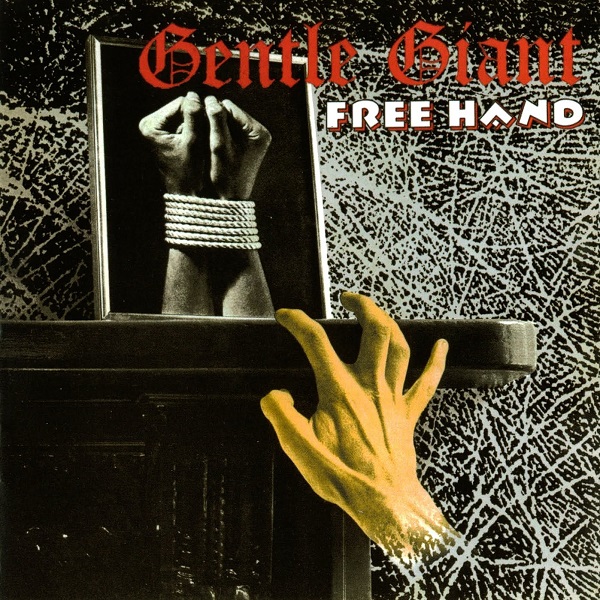
Free Hand (Gentle Giant, 1975)

Luckily one of the most devilish prog rock songs ever, based on jazzy (and also folkish) keys and a fast tempo ballad, but also including an amazing series of changes, interludes, musical instruments and variations on the main theme. It is almost impossible to label such a song (and any GG's song, as to that), but "Free Hand" has what I call a touch of magic, with all those luna park sounds and syncopated rythms.

"Free Hand" was the seventh studio album by Gentle Giant.

The unifying sung theme dances between the incredible list of instruments required by this track, things like clavinet, synth, electric piano, woodbklock, cowbell... simply anything they could get their hands on! This is Gentle Giant, my friends: nothing is predictable or usual, still such a challenging music is never unpleasant. As they say: Now my hands are free from the ties!

Monday, 2 January 2017

18400 TL (21.Peron, 1975)

First of all, 1975 can be only considered as an approximate recording year for this track. 21.Peron were no doubt one of the best Turkish rock bands of their era, but they never released an official album during their active years, so that their 1975-77 songs were only made available on a physical support in 2003. This song is simply perfect to me: sweet and melodic, but also experimental and acid.... that's what I call prog rock!
 
Arkaplan label released this compitation including 12 songs.
 
The bass lines are the unifying frame of "18400 TL" (by the way, TL stands for Türk Lirası, the national currency unit), but I higly recommend Andreas Wildermann's organ too, so warm and so... Seventies! Here and there you'll recognize Turkish folk elements (mainly provided by Alp Gültekin's viola), bluesy measures, heavy rock riffs and psychedelic memories, but the whole pattern is solidly symphonic. When I listen to such short lived bands, I wonder how many good albums never saw the  light...

Thursday, 14 July 2016

The Hermit (Steve Hackett, 1975)

This highly atmospheric song, based on acoustic instruments and on a misty, fairy inspiration, perfectly illustrates Steve Hackett's magical side. Like in an ancient and forgotten English garden, the listener follows a moisty path through the wild, guided by a far away lantern. There he'll find the hermit and, of course, Steve himself playing some folkish tune with his elven friends. The melancholic mood of the instrumental final section is so deeply heartbreaking and John Hackett's flute has such a mysterious call that I'm always compelled to start the song once again and enjoy its charms one more time.

The Hermit as seen on the album, drawn by Kim Poor.


IMHO, "The Hermit" is a perfect example of progressive ballad and somehow it announces the forthcoming "intermediate" Genesis era. And it also proves how much Steve influenced the band's musical choices in a trying passage of their career. When listening to this song, I finally see how precociously mature Steve's talent got...

Friday, 10 June 2016

L'Araignée-mal (Atoll, 1975)

One of the most surprising, unpredictable fruits of the lushing French Prog garden from the Seventies, this song is the title-track of the sophomore work by Atoll, the well known Metz-based crossover band. The gloomy and obsessive bass line of this song, along with the dramatic and theatrical vocals, create an original mood, mid-way between Ange and Magma, or between symphonic rock and RIO.

Atoll's line-up as seen on "L'Araignée-mal" back cover.

The lyrics and the music deal with madness and seclusion, but also with a distant, persistent hope, underlined by a dreaming guitar solo and some Mellotron chords in the final section of the track. The inner anguish and the struggle for a brighter perspective turn music into emotion and sounds into a lifelike experience. That's why, even if Atoll wrote more effective and more pleasant melodies during their career, I couldn't leave "L'araigné-mal" out of this humble blog.

Thursday, 21 April 2016

Les Porches de Notre-Dame (Maneige, 1975)

What a beautiful suite this is! Maneige were no doubt one of the best band from Québec, and also one of the most open-minded ones, with their eclectic musical blend and their rich instrumentation. "Les Porches de Notre-Dame" ("Notre Dame Archways") are a 19 minutes long suite divided into six movements, full of acoustic instruments and mainly instrumental. The sacred-sounding "Ouverture" immediately inspires a spiritual tension and a quiet, visionary mood. The entire track displays this supernatural and nonetheless humble atmosphere, where traditional instruments bring back the Middle Ages and a wind-driven chamber music ensemble.

This suite opens "Les Porches", the second studio work by Maneige.

Grace and delicacy rule this composition, but you'll also find stingy, unquiet moments in it, especially when the piano comes in. The last and longest section also includes the only sung part of "Les Porches de Notre-Dame" and the listener is overwhelmed by Raoul Duguay's singular voice and by his trombone, not the most usual instrument in modern music. Finally, this is an unforgettable musical experience, if you believe me.

Saturday, 2 April 2016

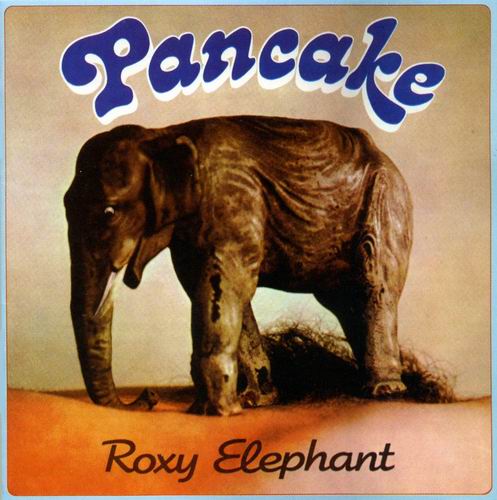
Aeroplane (Pancake, 1975)

Charming, that's the word. Pancake were a German band based on two guitars, two bass guitars and no keyboards at all. Nonetheless, their sound is a well recognizable '70s prog rock, with slight folk (or even country) roots and a tasty acid smell. This "Aeroplane" comes from the band's debut album "Roxy Elephant", most likely their best work. It's so pleasant a track that I was surprised, after listening to it for the first time, to discover that it was more than 13 minutes long!

After this debut LP, Pancake released two more albums.

The matter is that it flows away so naturally, displaying its rythmic changes, vocal harmonies, psychedelic effects and sweet guitars, that I bet you'll like it the way I did and do. I still haven't decided if I better like the electric solos or the acoustic moods, the Gilmour-esque side or the Phillips-ian one of this track. Does it really matter?

Saturday, 26 March 2016

Inquinamento (Libra, 1975)

Libra are usually considered as an Italian prog band from the '70s, even if just a few of their thacks actually has prog elements in it. This is the case with this long song titled"Inquinamento" ("Pollution" in English) and coming from their debut album "Musica e parole". This music has a fluid structure, with many musical changes and a spoken set of lyrics in romanesco, the local language of Rome and its Region. These lyrics are about pollution, of course, and about the illegal exploitation of Nature.

Libra were from Rome and also liked jazz rock.
 
The music describes such a corruption in an effective way, gathering sweet sounds and dissonant effects in a surprising but never unpleasant series of sketches. I really like the guitars here, so sharp and so... Seventies! Not surprisingly, their kind of prog will prove itself suitable for movie soundtracks and theatrical productions.

Tuesday, 8 March 2016

Ommadawn part 1 (Mike Oldfield, 1975)

Useless to say, Mike Oldfield is one of the best composers when it comes to long and folky suites and I think it's a shame that most of the reviewers out there limit themselves to his first and most celebrated album. Ommadawn part 1 is a 19 minute, deep and dreamy composition lining up a series of heartbreaking themes and fascinating moods. This time Mr. Oldfield didn't play all the instruments, on the contrary there are many guest musicians and a well assorted group of vocalists, including Sally Oldfield. 

"Ommadawn" was the third studio album by Mike Oldfield.

Among those contributions the listener appreciates many acoustic and traditional instruments like Pan flute, uillean pipes and cello. Oldfield himself focuses on guitars and keyboards and for sure his acoustic and electric guitars and his trademark mandolins add the usual sweet, airy and intense touch to the suite. Once more, this is high emotional music, flowing like inner waves, but thanks to the well written melodies and the flushing arrangements, it never goes merely ambient. In a word: that's Mike Oldfield, folks!

Monday, 15 February 2016

Minstrel in The Gallery (Jethro Tull, 1975)

When it comes to folk / rock / classical cohabitation, Jethro Tull deserve our greatest respect and our highest gratitude. "Minstrel in The Gallery", for example, is a well mixed and even better set up specimen of crossover song, starting like a Tudor era piece of music - including minstrels and dance room galleries - then going heavy and fully rock (Mr. Barre is simply great here) and finally drawing all the baroque'n'roll style and the flute features we love. 

An edited version of this painting, "Twelfth Night Revels in the Great Hall, 
Haddon Hall, Derbyshire", by Joseph Nash (1838) was adopted for the cover art.
 
This dynamic profile and the manifold structure of the track are especially admirable in the album version, lasting more than 8 minutes. Useless to say, the minstrel of the song was going to get the alter ego of Ian Anderson since the first live performance of the track... for sure, my favourite mistrel ever!

Sunday, 3 January 2016

In The Wake of King Fripp (Heldon, 1975)

The French band Heldon went through many styles and moods during their career, but surely the second album "Heldon II Allez Teia", including this opening track, is their mellowest work. As revealed by the title, this is a patent hommage to Robert Fripp, set up by Heldon's leader Robert Pinhas. You could name thousands of derivative tracks in our genre, but this one, at least, is openly stated in the first place. Abandoning their usual electronic experiments,

Heldon were a foursome for this album... with no drummer at all!

Heldon perform a pastoral instrumental, full of Mellotron and even acoustic guitars. That said, in this piece of music there's more than meet the ears: an ambient flavour, a spacey influence, an acid background that enrich the Crimsonian sound and put it further along a somewhat weirdest path. That's why I like "In The Way of King Fripp": wrapped up as a kind present to Mr. Fripp himself, it actually explores winding roads and hypnotic alleys... a treat I still enjoy so much...

Friday, 11 December 2015

Merlin The Magician (Rick Wakeman, 1975)

If you need a further proof of Rick Wakeman's capacity to melt epic and ironic tones, "Merlin The Magician" is perfect for you. Not only it is a stunning piece of prog music and (useless to say) full of keyboards, but it also features rather humorous lyrics about Merlin, described as both a magic and laughable character. That said, what I really like in "Merlin The Magician" is the manifold and shimmering instrumental section, a very long one, along with the beautiful sung themes Rick wrote.


This must be Merlin... or maybe Rick The Magician. Same thing.


The entire "The Myths And Legends of King Arthur And The Knights of The Round Table" album is one of my favourite works by Wakeman, but surely this song in one of its brightest highlights. I see Merlin himself coming out of Rick's synths and cheerfully smiling to the listener. It's a kind of magic. Prog magic, I daresay. 

Wednesday, 18 November 2015

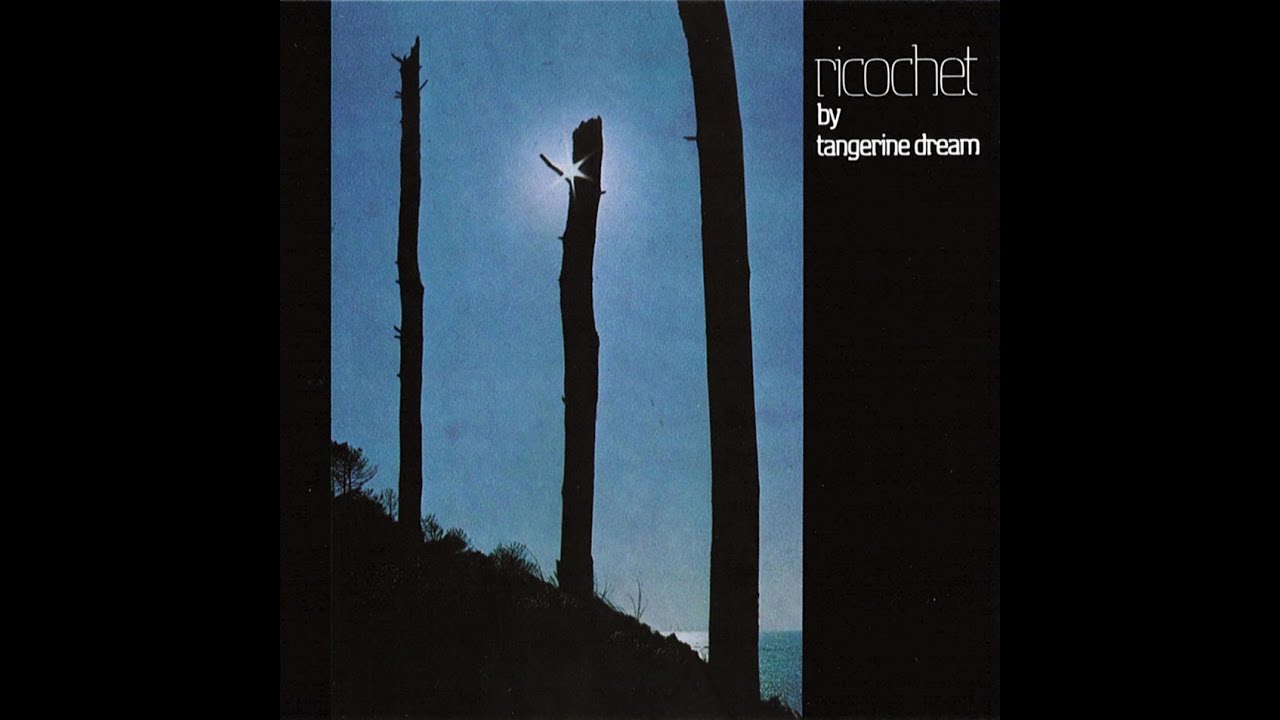
Ricochet Part One (Tangerine Dream, 1975)

Following the example of other prog giants of the '70s, Tangerine Dream performed and recorded live an entire LP of unreleased music. That was a two part composition called "Ricochet" and continuing the band's complex, atmospheric and electronic exploration, but with a more intense rythmic work. The first part of the album evolves from a beautiful and somehow arabic theme that provides the returning element of the track and a basic sequence undergoing a stunning series of variations, edits, dismantlements and re-creations.

Ricochet was recorded during August-October 1975 European tour.

Froese, Baumann and Franke offer an exciting and arcane piece of music, criss-crossing irregular rythms, space effects, inner visions and acid touches in such a fascinating song that Ricochet still stands today as a real monument of what someone calls krautrock or quite simply of electronic music. And for once in this blog, I don't need to add IMHO.

Saturday, 26 September 2015

Welcome to The Machine (Pink Floyd, 1975)

One of the most claustrophobic and impressive portraits of the entertainment business ever. The great deal of synths employed here probably is the signature feature of "Welcome to The Machine", and the way those electronic devices interact with the acoustic guitars and a plethora of tape effects is even more peculiar. This song quickly became a popular standard of floydian sound, mixing slow bluesy measures, space rock and basic ballads into a fascinating melting pot. 

Cartoonist Gerald Scarfe created a disquieting video for this song.

Even more, the lyrics of this track, staging a dialogue between a record industry manager and a wannabe pop star, was the iconic rendition of a then widespread cliché about the pretended constrast between the rock and roll rebellion and the greedy record companies. For sure, the noise of the packing machine closing the song never abandoned an entire generation of listeners.

Wednesday, 16 September 2015

Tulen Pisara (Fantasia, 1975)

This arcane, atmospheric and somehow disquieting track comes from the only album released by Fantasia, a Finnic band active during the 70s. Their eclectic vein ranges from the romantic accents to the jazzy arrangements, including a good deal of acid guitars. "Tulen Pisara" offers a sweet and rather melancholic sung theme, some interesting vocal harmonies and a liquid instrumental central section that really brings the listener to the lysergic era.

Fantasia disbanded in 1979 releasing only this self-titled work.

The keyboards provide a misty background on which the guitars draw their winding and effective pattern. I sometimes wonder how many prog pearls like this one hid themselves in dusty and forgotten shelves. Disbanded bands, long gone experiments, one-album acts from the end of the world... I'm grateful to all those digging into the prog rock history and giving to those songs a second chance.

Wednesday, 2 September 2015

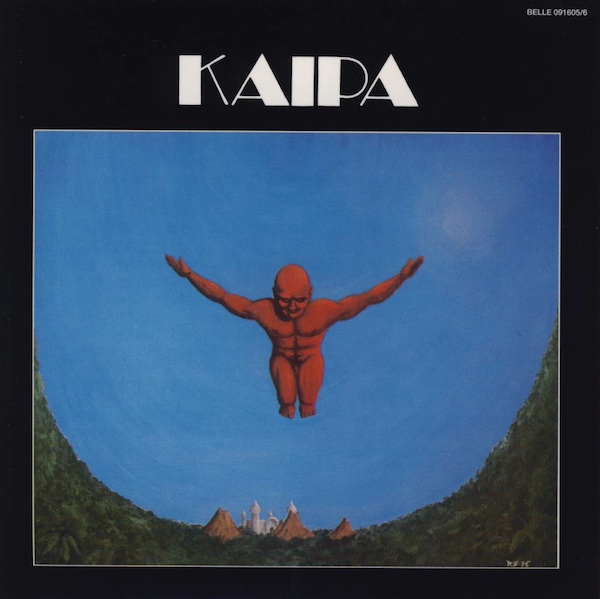
Ankaret (Kaipa, 1975)

The gracious baroque intro of "Ankaret" ("The Anchor" in English) seems to be the prelude to a classically inspired track. Well no, there's more than this. True, the intro theme comes back and its chamber music measure is one of the highlights of the song. But there are many others: rock, jazzy, choral, even pop moments delight the listener and show how diversified and unpredictable these Swedish musicians were in 1974... and all along their career.

I reckon this is one of the best debut albums ever...

Tomas Eriksson's bass guitar is everywhere and provides a pulsing background to Roine Stolt's guitar and, of course, to Hans Lundin's keyboards. The solos and the interplays between all the musicians are simply perfect and each change intriduces something new. So, if I'm fond of "Ankaret" it's just because it is a brilliant specimen of what progressive rock is in my very, very humble opinion. Waiting for yours...

Wednesday, 19 August 2015

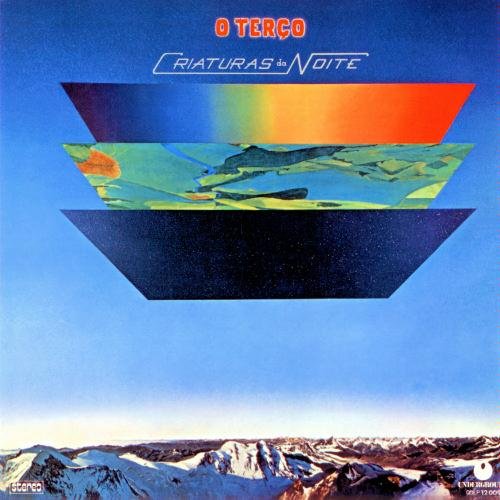
Criaturas da noite (O Terço, 1975)

O Terço recorded the album "Criaturas da Noite" in 1975 and this still can be considered their best LP. It was one of those enlightened pop albums where melodies and discreet prog elements coexisted with the special grace and the simple arrangements that single out many South-American bands. The title track is a slow, delicate ballad enriched by an orchestral bridge and effective vocal harmonies.


Of course, if you're into tricky or experimental music, please choose another post (or even another blog: I'm not a jealous guy!), but if ever you like - from time to time - an easy and not trivial song, a caressing theme and a nocturnal mood, this is the song for you. Enjoy, then.

Thursday, 13 August 2015

En el hospicio (Pastoral, 1975)

This title track, taken from the second studio work of Argentinian duo Pastoral, is a very good example of simple and effective folk rock with many and welcome elements of prog rock. The plain ballad forming the essential part of the song is enriched by electric guitar bridges, well done vocal harmonies, a touch of keys and a coherent, discreet drumming. The track starts with a bare acoustic guitar plus vocals intro, then the other instruments come in and here you are a soft and rather easy version of progressive rock.

Pastoral were Alejandro De Michele and Miguel Angel Erausquin.

Even if the song is a very short one, I can tell some strong points, like the guitar solo (a very good one, believe me), the organ underlining the chorus and - of course - the final reprise of the acoustic intro. If you read or speak Spanish, you'll also find interesting lyrics, in the vein of protest songs, a popular genre during the '70s. If you don't, then enjoy the music... it should be enough to re-listen "En el hospicio" very soon.

Sunday, 9 August 2015

Mediterraneo (Pooh, 1975)

This instrumental track comes from "Un po' del nostro tempo migliore", luckily the best and proggest album by Italian pop band Pooh, one of the most popular Italian acts ever. Dodi Battaglia's guitars are (as usual with Pooh) the main feature of "Mediterraneo" and they actually draw a Mediterranean sketch, full of sweetness and strong colours. The other instruments come in discreetely and a background choir finishes the picture.

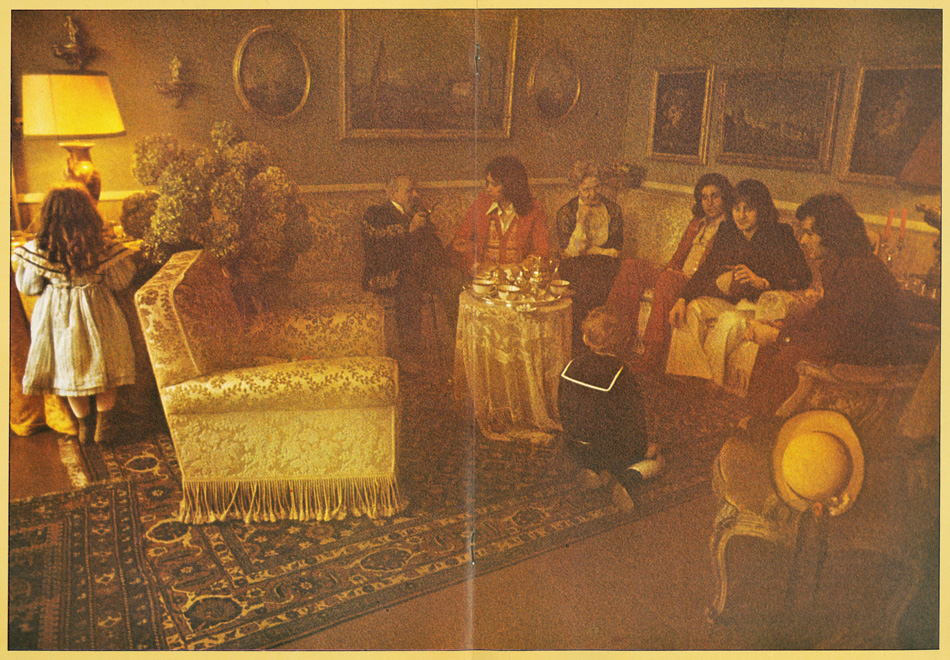
A Victorian drawing room for Pooh.

You couldn't imagine anything more Italian, nonetheless the tubular bells plus the mandolin provide a clear reference to Mike Oldfield's debuit work and the original LP package has a Victorian taste. It's a distressing and delicate pattern, a highly evocative and descriptive track I still like after so many listening sessions...

Thursday, 23 July 2015

Fenris (Ragnarok, 1975)

Kiwi prog scene probably is the least known among the progressive scenes of English speaking Countries. That said, Ragnarok have their worldwide cult fandom and I think they deserve far more than this. They had an original style, somewhere between space rock, mainstream rock and prog. They created a special sound, full of good melodies and strong constrasts. See how they mix acid riffs and celestial keys un this "Fenris", listen to Lea Maalfrid's beautiful voice, a female version of Geddy Lee's (or a male version of Jon Anderson's? lol...).

This track comes from Ragnarock's self titled debut album.

What I actually like here is the sense of proportion: never too rock, never too electronic, an excellent mix of guitars and keys, rythmic background and melodic lines, finally a perfect balance between sung and instrumental sections. P.S.: Not to be confused with a bunch of other bands bearing the same name. Probably our friends from Auckland started a trend and they did it without knowing.