Showing posts with label 1967. Show all posts

Friday, 30 December 2016

Mad Man's Worries (Mother's Love, 1967)

Lost somewhere in the dark land between proto-prog, blues, beat and psychedelic rock, Mother's Love were a challenging Dutch band whose music had acid edges and sweet acoustic parts. This track comes from their only album "Take One" and shows how eclectic their inspiration could be. The flute meets a liquid bass line and good vocal harmonies, while the song pattern includes some changes and an unusually shuffling sung theme.

How many musical treasures are the Sixties still hiding?

Floris Kolvenbach's vocals are among the highlights of "Mad Man's Worries", full of passionate and crazy-like passages and finally merging into the chaotic finale. One again, this is not exactly what we call prog rock, but it includes all that open minded approach that subsequently would provide the perfect culture medium for the new genre.

Sunday, 28 February 2016

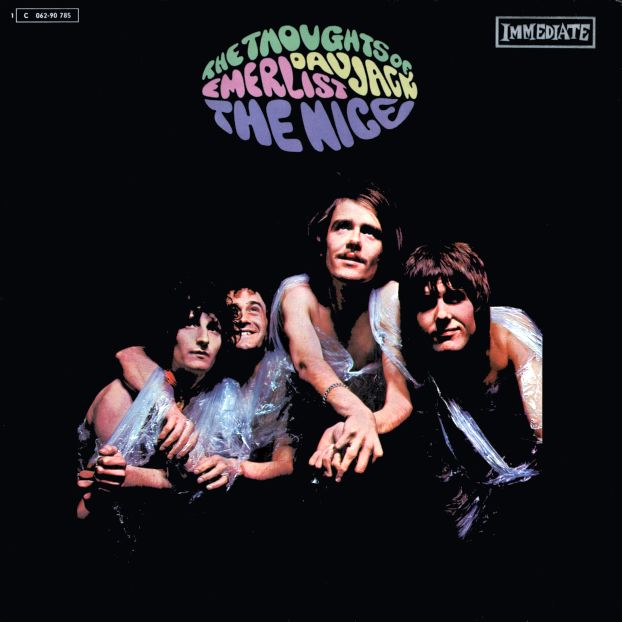
Rondo (The Nice, 1967)

"Rondo" is one of the most celebrated tracks from "The Thoughts of Emerlist Davjack", the debut album by The Nice. Packed with jazz and classical quotes (Dave Brubeck is credited as one of the authors, Bach is still waiting...), "Rondo" will go into many variations during The Nice's and Emerson's career and also is one of the earliest prog pearls ever. The devilish rythm of this instrumental actually fits into lavish rock shows and the foursome performance surely was a riveting one.

The guys were K. Emerson, L. Jackson, D. O' List & B. Davison.
In short... Emerlist Davjack!
 
What should I choose as my favourite highlights? The guitar solo? Emerson's Hammond? The rythmic cavalcade? The coherent and colourful architecture? Or maybe the short church organ tribute to JSB? That's an impossible choice, IMHO: one has to take it or leave it as it is. I take it, and I'm sure I'm not the only one.

Tuesday, 1 September 2015

Susan Song (Le Stelle di Mario Schifano, 1967)

Le Stelle di Mario Schifano were a short lived band that definitely deserves a special place in my blog. Actually, some of the songs included in their debut LP anticipated the so called Italian prog and even some British prog elements. That's the case with "Susan Song" and its lunar mood: it seems to me like Le Orme five years before their "Collage" album, and it also reminds me of "Moonchild" by King Crimson... and please remember we're in 1967! Of course, there is a strong naive accent in "Susan Song", and the vocals aren't exacly good, but the soft, delicate and even acid atmosphere of this track strikes me.

The extra-rare original red vinyl pressing of the album.

There is also another prog element in this band: their artistic relashionsip with the painter Mario Schifano, who not only gave them his name but also suggested a series of live visual effects and, of course, provided the cover art of their unique studio album, featuring the stars ("Stelle" in Italian) that finished the band's name. They weren't successful in 1967, but we can listen to their songs with a renewed interest now we're... wise after the event!

Tuesday, 26 May 2015

Being for the Benefit of Mr. Kite! (The Beatles, 1967)

Of course, this isn't a prog song, it simply couldn't be. That said, "Sgt Pepper's Lonely Hearts Club Band" is one of the most quoted and listed pre-prog albums. This song, in particular, features a lot of elements that perfectly fit into the proto-progressive mood. First of all, it's one of the more complex and colourful songs by The Beatles, packed with organ sounds, overdubbings, tape loops and assorted weirdness. This need for intricacy and the crossover nature of the track are the breeding ground on which our favourite genre will rise.

A seminal album. And not only for prog pre-history...

The lyrics confirm such a reading, being inspired by a XIXth Century circus poster and including a good deal of double entendres and allusions, in a vein that many prog bands will exploit some years later. Last but not least, this is a beautiful song, concealing a well written melody into a tricky package. And that doesn't sound new in this blog. So, not prog, you're right, but not so far from that...

Wednesday, 27 August 2014

Nights in White Satin (The Moody Blues, 1967)

Do The Moody Blues really belong to the prog rock movement? For sure, they anticipated many of the fundamental features of the genre, as their "Night in White Satin" hit easily proves: a well arranged fusion of classical music and pop rock, instrumental interludes (in the album version, at least), mood changes and, of course, the inclusion in a concept album, the band's second one, titled "Days of Future Passed". The concept was about the different times of a day, so that "Nights in White Satin" represents - of course - the night and closes the album.

This song was released as a single in 1967, 1972 and 1979,
always charting, and had of course many different cover arts.

The orchestra plays a central role in the long version of the song and it does so without any sharp contrast with the band: each moment has its own space and role, even the spoken comment during the final part of the song, a section that also had an originally unlisted title of its own, "Late Lament". The famous and beautiful sung melody fills the first part of the track and goes through different arrangements, so that each verse of this airy ballad seems to add something new and different. Prog or not, this band (and this track) strongy contributed to the building of a new musical era.

Saturday, 1 February 2014

Repent Walpurgis (Procol Harum, 1967)

This is probably my favourite Procol Harum's track, an instrumental piece dominated by Matthew Fisher's Hammond and Robin Trower's electric guitar. The delicious central piano interlude is also an excellent idea an the majestic pace of the song is simply stunning. No other tracks in 1967 were as prog as this one, no other tracks anticipated so many features of our genre, and after all just a few other bands played such an important role in building up a musical era.

Procol Harum released this 7" single for the Italian market,
including "Il tuo diamante" (an Italian version of "Shine on Brightly")
and - as a B side - "Repent Walpurgis" renamed "Fortuna".

Gary Brooker & friends succeeded in mixing up classical themes, pop-rock riffs and a pinch of folk. This track is still fresh today, but we should never forget how new and bold it was in 1967 and I'll never forget to thank Procol Harum for this. Ah, by the way, Walpurgis was a VIIIth Century British female missionary whose celebration day once coincided with the Witches' annual rendezvous with the devil.

Wednesday, 16 October 2013

Astronomy Domine (Pink Floyd, 1967)

It is Always difficult to say something more about such a famous and inspiring song. "Astronomy Domine" is the opening track of the first Pink Floyd's album, "The Piper at The Gates of Dawn" and one of the most strictly linked to Syd Barrett, the first and not forgotten leader of the band. Music and lyrics draw the picture of a fantastic stellar trip Barrett did under the LSD influence. The bass line is somewhat distressing and the dramatic and psychedelic repetition of sounds and rythms enhance the gloomy mood.

Syd Barrett singing "Astronomy Domine".

But there is also a synfonic though chaotic wall of sound describing a whirling universe, something like a Van Gogh's sky. I also like the working sub-title of this song, "An Astral Chant", reminding me of an ancient ritual, the well known unusual chord progression and the hypnotic series of planet and moon names in the lyrics. The word for all that is devastating.

Tuesday, 2 April 2013

A Whiter Shade of Pale (Procol Harum, 1967)

This is not just a song, this is a myth and a gateway open to the prog rock era by one of the most underrated bands ever. It is diffucult to say how much this track influenced the end of sixties music world, but any time I listen to it, I can't help getting more and more convinced this was a real turning point in rock history. I know, other artists tried a successful combination of pop-rock and classical patterns ("Eleanor Rigby" is there to prove what I'm saying), but here the fusion is perfect and you can't tell what's rock and what's not: it's a seamless single piece of art, not a pop song with orchestral arrangements.

Soberly dessed Procol Harum.

Furthermore, this blending contains traces of r'n'b and psychedelia, so that one could say this was the mirror of its season and its worldwide huge success certainly inspired many artits to follow this path and to build up a new, hybrid idea of rock'n'roll. In short, progressive rock was born. Even the metaphysical lyrics announce a new trend others will make the most of, but Procol Harum were there first... and that's saying something.